
If your books are weeks, months, or even years behind, you already know the feeling: the pile keeps growing, every deadline gets scarier, and starting feels impossible. Here’s the part nobody tells you — catching up is routine work for a bookkeeper. There’s no judgment and no lecture, just a process.
BKInk’s catch-up bookkeeping services take the backlog off your plate: every transaction entered and categorized, every account reconciled against real bank and credit card statements, month by month until your books are current and you can finally see where your business stands. We work remotely with small businesses across Ontario, in QuickBooks Online or from whatever records you have.

Signs your books are behind
Some businesses know exactly how far behind they are; most just feel it. The signs look like this: bank statements that pile up unopened, a bookkeeping file nobody has touched since last tax season, invoices you’re not sure were recorded, HST periods filed from bank-statement math (or not filed yet), and that recurring promise to “sort the books out next weekend.” If your accountant’s last question was “can you send me your records?” and your honest answer was a shoebox — this page is for you. The wider picture of how backlogs connect to other bookkeeping problems is on our bookkeeping and accounting problems guide.
Why backlogs grow
Falling behind isn’t carelessness — it’s arithmetic. You’re running the business, and bookkeeping is the one job that never shouts when it’s skipped. Each quiet month makes the job look bigger, so it gets skipped again; by the time the pile matters, it looks too big to face, and the safest-feeling move is to not look at it. Software alone rarely fixes this, because the problem was never the software — it’s that the work needs hours someone actually has. That’s the whole reason catch-up bookkeeping exists as a service.
Catch-up bookkeeping or cleanup for QuickBooks Online — which one do you need?
The two are easy to confuse, and some businesses need a bit of both. Catch-up bookkeeping fills in the periods that were never done: transactions that were never entered, months that were never reconciled, HST that was never tracked. A cleanup for QuickBooks Online fixes work that was done but done wrong — duplicates, miscoded transactions, reconciliations that never reached zero, broken bank feeds. If nobody has touched the books since last tax season, you need catch-up. If someone has been entering things but the balances don’t make sense, you need a cleanup for QuickBooks Online. If both are true, we scope them together in the same review so you get one plan and one quote, not two diagnoses.
What BKInk may review
Before quoting anything, we look at what’s actually there: which months are missing or incomplete, the state of your QuickBooks Online file (or spreadsheet, or shoebox), how many bank and credit card accounts are involved, transaction volume, whether HST has been tracked or filed for the backlog period, and whether payroll ran during it. That review tells us — and you — the real size of the job. If the file itself also has errors (duplicates, broken reconciliations, miscoded history), that’s a cleanup for QuickBooks Online, and we scope the two together in the same review so nothing is diagnosed twice.
The staged catch-up process
Stage 1 — Free consultation. You tell us how far behind things are and what prompted the catch-up — a filing deadline, a loan application, or just being done with the stress. No preparation needed.
Stage 2 — Records review and gap list. We look at what exists, list exactly what’s missing, and tell you where to find it (most of it comes straight from your bank).
Stage 3 — Clear scope and quote. Catch-up is priced by the months of backlog and the volume involved — the structure is on our Pricing page — and you get a specific quote before any work starts.
As a planning guide, catch-up work often starts around $200–$400 per month of backlog, scaling with volume and complexity — an illustrative range, not a binding quote; your exact price is confirmed after a free consultation. Prices shown do not include HST.
Stage 4 — The catch-up. We work through the backlog month by month: transactions entered and categorized, accounts reconciled to statements, HST tracked for each period as we go. You’ll see progress in stages, not silence until the end.
Stage 5 — Current books, kept current. We hand over books that are up to date and reconciled, and most clients roll straight into monthly Bookkeeping Services so the backlog never rebuilds.
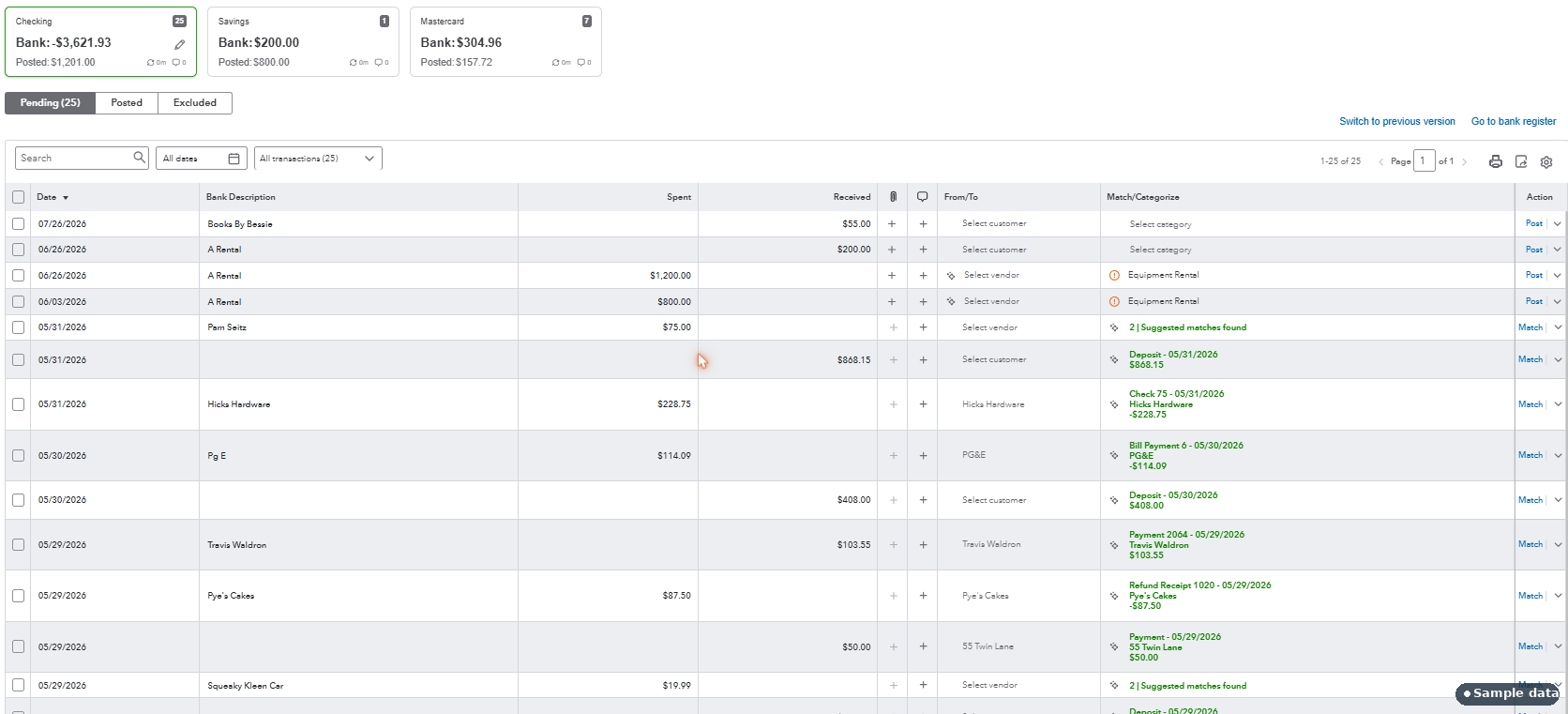
This is where much of the work happens — the bank feed, where months of transactions wait to be matched and categorized:
Records you may need to provide
Fewer than you’d fear. For most catch-up projects the list is short:
- Bank and credit card statements for every month of the backlog — downloadable from your bank in minutes, and the backbone of the work.
- Sales records or invoices, if you issue them, so income is recorded against the right customers.
- Payroll records, if you had employees during the backlog period.
- Copies of any HST returns already filed, so the periods we rebuild line up with what has been reported.
- Loan statements and major purchase documents, so balances and assets are recorded correctly.
- Access to your QuickBooks Online file if you have one — or the spreadsheet or shoebox if you don’t.
If something specific is needed to resolve a transaction, we ask for that item — we don’t send you off to reconstruct a year of paperwork before we’ll start.
What periods can catch-up bookkeeping cover?
Any period where records exist. Many projects cover the current fiscal year plus the one before it, but multi-year backlogs are routine — several years is simply more periods of the same process. Typical situations include a prior fiscal year that still needs a tax return, the gap since a previous bookkeeper left, the months since a business incorporated or changed banks, and a business that has been running for years without books at all. Where bank statements are the only records that survive, we rebuild from those and note clearly what could not be supported. We always work through the periods in order, oldest first, because every bank reconciliation depends on the one before it.
How catch-up connects to HST, payroll, and tax season
Catching up the books is usually the key that unlocks everything else. Once each backlog month is reconciled, your HST for those periods is finally built on real numbers instead of guesswork — see our HST Filing Services for how tracking and filing work from reconciled books. If payroll ran during the backlog, we make sure wages and source deductions are properly recorded in the books, alongside our Payroll Services. And when tax season arrives, current books turn year-end from an archaeology project into a handoff — your return gets prepared from records that are already organized. Catch-up is also the natural first step before ongoing monthly bookkeeping: current books first, then a routine that keeps them that way.
Getting tax-ready: catch-up before year-end
If a filing deadline is what prompted the catch-up, say so at the consultation. We sequence the work so the periods your accountant needs are reconciled first, and we hand over what year-end actually requires: reconciled bank and credit card accounts, an HST summary by period, and a general ledger with the supporting reports. From there, our Corporate Year-End Support or Personal Tax (T1) service — or your own accountant — can prepare the return from real, reconciled numbers instead of estimates.
What catch-up bookkeeping doesn’t include
An honest boundary, in plain terms: catch-up bookkeeping is bookkeeping. It brings your records current and reconciled; it is not an audit, review, or assurance engagement, and it isn’t tax, financial, investment, or legal advice. We don’t promise completion by a specific date before seeing your records, and we can’t promise anything about CRA outcomes, penalties, or interest — no honest bookkeeper can. What we can do is bring the books current so that whatever filings follow are prepared from real, reconciled numbers, and flag anything in the backlog that deserves a conversation about your specific situation.
Frequently Asked Questions
1. How far behind is too far behind?
We haven’t met it yet. A few months is quick; multi-year backlogs are genuinely routine — they just take more periods of the same process. The pile is almost always smaller than it feels once someone who does this every day starts sorting it.
2. How long does catch-up bookkeeping take?
It depends on the months involved, the transaction volume, and how complete your records are, so we scope it honestly after the records review instead of guessing. You’ll know the expected shape of the work before it starts, and you’ll see progress month by month rather than waiting for a single reveal.
3. What does catch-up bookkeeping cost?
Catch-up is a one-time project priced mainly by the months of backlog and the volume in them — the structure is explained on our Pricing page. You get a specific quote after the records review, before any work begins.
4. What if I’m missing receipts or records?
Very common, and rarely fatal. Bank and credit card statements rebuild most of the picture, and we’ll tell you exactly which gaps actually matter. Missing documentation is dealt with honestly — recorded for what it is, flagged where it affects what can be claimed — rather than papered over.
5. Will catching up fix my unfiled HST?
It does the part that matters most: once each period is reconciled, your HST for that period is finally based on real numbers, ready for filing — and our HST Filing Services can handle the filings themselves. What we won’t do is promise CRA outcomes; we prepare the numbers honestly and support you through the process.
6. What happens once I’m caught up?
You choose: take the current books and run them yourself — our free guides and checklists help there — or hand the routine to us as monthly bookkeeping so the backlog never returns. Most catch-up clients pick the second, because the backlog was never really about willpower; it was about hours.
7. Is catch-up bookkeeping the same as a cleanup for QuickBooks Online?
No. Catch-up fills in periods that were never recorded or reconciled; a cleanup corrects records that exist but contain errors — duplicates, miscoded entries, reconciliations that never balanced. Many backlogs need some of each, which is why our records review looks at both and quotes them together. See our cleanup for QuickBooks Online page for what a cleanup project involves.
8. Do I need catch-up bookkeeping before my taxes can be filed?
In practice, usually yes. A tax return is prepared from the books, so if the books for that year are missing or unreconciled, someone has to build them first. Catch-up does that part; your accountant — or BKInk’s tax preparation service — then prepares the return from the reconciled numbers.
9. Do you provide catch-up bookkeeping services across Ontario?
Yes. BKInk works remotely with small businesses across Ontario — Toronto and the GTA, Mississauga, Vaughan, Markham and beyond — using QuickBooks Online and secure document sharing, so your location doesn’t change the process or the price.
Ready to stop dreading the books?
Schedule a no-pressure consultation. Tell us how far behind things are — plain English is fine — and we’ll tell you exactly what catching up would involve and cost. If your QuickBooks file needs attention too, our Support for QuickBooks Online picks up from there.
This page is general information for Ontario businesses, not tax, accounting, or legal advice. Every backlog and situation is different — the free consultation is where we look at yours.