Bookkeeping Built for the Realities of Ontario Law Firms
Few businesses carry the bookkeeping demands a law firm does. Between trust accounts, client retainers, disbursements, and the record-keeping standards your profession is held to, the margin for error is thin. BKInk provides specialized legal bookkeeping for Ontario law firms, supporting your trust and general accounting with the accuracy and discipline your practice requires. We keep your books clean in QuickBooks Online, your trust records reconciled, and your HST and payroll organized, so you can focus on practising law with confidence that the numbers behind your firm are in order.
Please note: BKInk provides bookkeeping services, not legal or compliance advice. Responsibility for meeting Law Society of Ontario requirements remains with the firm and its licensees, and firms should confirm their obligations with the Law Society and their professional advisors.
Common Challenges
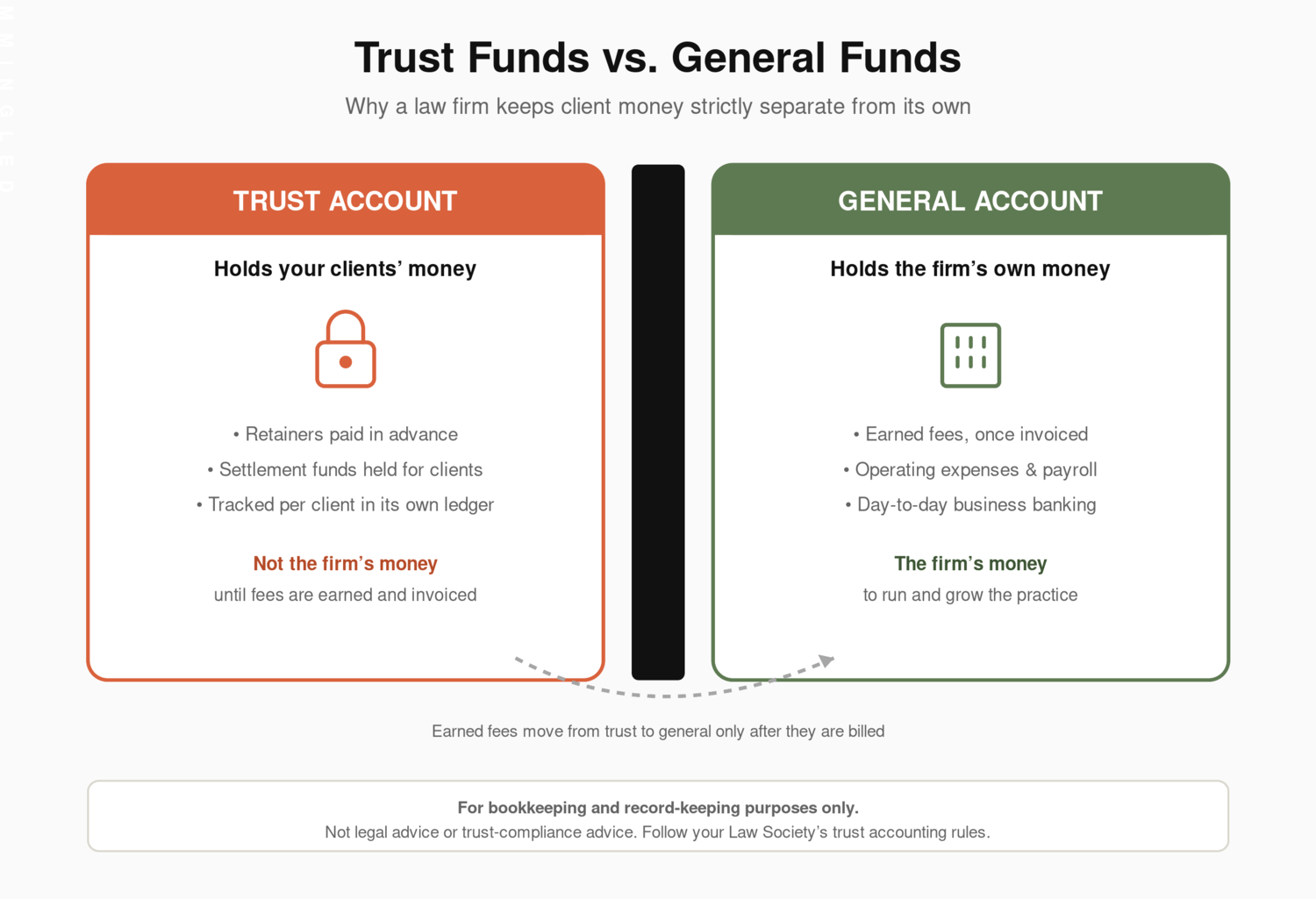
Law firm bookkeeping is uniquely unforgiving. Trust accounting sits at the centre of it: money held on behalf of clients has to be kept completely separate from the firm’s own funds, recorded precisely, and never commingled or drawn against improperly. The bookkeeping behind that separation has to be flawless, because errors here are among the most serious a practice can face.
Client retainers add their own complexity. Funds received in advance have to be tracked carefully as they move, recognized correctly as work is performed and amounts are billed, and reflected accurately in both trust and general records. Disbursements compound the picture, with costs advanced on a client’s behalf, such as filing fees, expert costs, and search fees, needing to be tracked against the right matter so nothing is lost or misallocated.
Layered on top is the expectation of meticulous, well-organized records and regular trust reconciliations that tie out exactly. Many firms run on software that wasn’t set up for the way legal accounting actually works, or rely on a generalist bookkeeper who doesn’t understand trust requirements. The result is reconciliations that don’t balance, retainers that are hard to trace, and a constant low-level anxiety about whether the books would hold up under scrutiny, all while the practice is busy serving clients.
How BKInk Helps
BKInk understands the operational realities of running an Ontario law firm and brings that understanding to your books. We maintain your bookkeeping in QuickBooks Online with the structure a legal practice needs, keeping trust and general accounting properly separated and supporting the disciplined, accurate record-keeping your firm is expected to maintain.
We support your trust accounting by recording trust activity carefully, tracking client retainers as funds are received and applied, and performing regular trust reconciliations so your records agree and discrepancies are caught early rather than at year-end. We track legal disbursements against the correct matters so advanced costs are never lost, and we keep your general books, HST, and payroll organized in one consistent system. Throughout, we work alongside your firm and your professional advisors, keeping the underlying bookkeeping accurate and well-documented so the people responsible for compliance always have reliable numbers to rely on. Whether you’re a sole practitioner or a growing firm, we tailor our support to how your practice operates.
Trust Accounting Support: What the Bookkeeping Involves
“Trust accounting support” is easy to say and specific to do. These are the records BKInk keeps for a law firm each month, and the guides where we explain each one in plain language.
Three-way trust reconciliation
Each month the trust bank statement, the trust general ledger and the total of all individual client trust ledgers are compared to one another; all three must agree, and any difference is investigated and documented rather than plugged. We prepare the reconciliation, keep the supporting listings, and flag anything that does not tie out while it is still small. How the three-way comparison works, and what usually breaks it, is covered in our trust reconciliation guide.
Client trust liabilities and individual client ledgers
Money in the trust bank account belongs to clients, so the books carry it as a client trust liability, broken down into a ledger per client and matter. We record every receipt and disbursement to the right client ledger, watch for any ledger that would go negative, and keep the client listing current so the firm can see exactly whose money is in trust at any time. See client retainer tracking for how retainers are received, applied and reported.
Retainers, disbursements and transfers to general
Retainers are tracked from receipt through to the invoice they are applied against; disbursements advanced for clients — filing fees, search fees, expert costs — are recorded against the matter so they are recoverable when billed; and transfers from trust to the general account are recorded only against amounts that have been billed and are properly supported. Our disbursement tracking guide walks through the recording.
Legal practice software alongside QuickBooks Online
Many firms run matter management and trust records in Clio, CosmoLex, Soluno or LEAP. BKInk keeps the QuickBooks Online general and trust bookkeeping accurate and reconciled alongside that software, so the two agree at month-end. Our guide to QuickBooks Online for Ontario law firms explains the setup, and trust accounting basics is the starting point if your firm is new to it.
Month-End and Year-End Workflows for Law Firms
Every month: the general bank and credit-card accounts are reconciled; the trust account is reconciled three ways; retainer balances and disbursement recoveries are reviewed; HST is tracked and, where due, filed; payroll and source deductions are run for staff. You receive the reconciliation package and a short financial summary.
At year-end: the firm receives a reconciled general ledger, the trust reconciliations and client trust listings for the year, the disbursement and HST summaries, and the reports your accountant and your firm’s annual filings draw on. From that file BKInk’s corporate year-end support and T2 preparation can complete the corporate return, or your existing accountant can. The compliance conclusions remain the firm’s and its advisors’; the bookkeeping behind them is complete and current.
Key Benefits
- Disciplined trust accounting support with trust and general funds kept properly separated and trust activity recorded accurately and consistently.
- Regular trust reconciliations that tie out, so discrepancies are caught early instead of surfacing as year-end surprises.
- Retainer and disbursement tracking by matter so advanced funds and client costs are always traceable to the right file.
- Clean general books, HST, and payroll in QuickBooks Online giving your firm one accurate, well-organized financial picture and records ready when you need them.
Why Choose BKInk
- QuickBooks Online expertise — We structure and maintain QuickBooks Online for the way legal accounting actually works, not generic defaults.
- Canadian bookkeeping knowledge — We understand CRA requirements, Ontario HST rules, and payroll obligations, and we support the bookkeeping behind your trust records.
- Industry specialization — We focus on the operational realities of Ontario law firms, from retainers to disbursements to trust reconciliations.
- Responsive support — You get a real, dedicated bookkeeper who responds quickly, not a call centre or a once-a-year check-in.
Frequently Asked Questions
1. Do you understand trust accounting for Ontario law firms?
Yes. We specialize in supporting the bookkeeping behind law firm trust accounts, including keeping trust and general funds properly separated, recording trust activity accurately, and performing regular trust reconciliations. We provide the bookkeeping support, not legal or compliance advice; responsibility for meeting Law Society of Ontario requirements stays with the firm, and we work alongside you and your advisors to keep the underlying records accurate and reliable.
2. How do you handle client retainers?
We track client retainers carefully as funds are received and then applied, so the movement of those funds is reflected accurately in your records as work is performed and amounts are billed. Clear retainer tracking keeps your trust and general books consistent and makes it easy to see what’s held and what’s been earned at any time.
3. Can you keep our trust reconciliations current?
Yes. We perform regular trust reconciliations so your trust records agree with the corresponding bank records and any discrepancies are identified early. Keeping reconciliations current throughout the year means you’re never scrambling to make things balance, and your records stay well-organized and ready for review.
4. Do you track legal disbursements?
We do. Costs advanced on a client’s behalf, such as filing fees, search fees, and expert costs, are tracked against the correct matter so nothing is lost or misallocated. That keeps your disbursements accurate, recoverable, and tied to the right file when it’s time to bill.
5. Can you handle our HST and payroll too?
Yes. Alongside your general and trust bookkeeping, we keep your HST tracked and filing-ready through our HST Filing Services, and we run payroll for your staff, including CRA source deductions, through our Payroll Services. Handling everything in one system keeps your firm’s records consistent and compliant.
6. What software do you use for law firm bookkeeping?
We work in QuickBooks Online, structured for the needs of a legal practice. If your firm also uses dedicated legal practice-management and trust-accounting software such as Clio, CosmoLex, Soluno, or LEAP, we focus on keeping your QuickBooks Online bookkeeping accurate and reconciled alongside it. If your file needs setup or cleanup first, our Support for QuickBooks Online can take care of that.
7. What is a three-way trust reconciliation?
It is the monthly comparison of three figures that must agree: the reconciled balance of the trust bank account, the balance of the trust liability account in the general ledger, and the sum of every individual client trust ledger. If they agree, the trust records are internally consistent; if they do not, the difference is investigated and documented. BKInk prepares this reconciliation each month as part of law firm bookkeeping.
8. Do you provide legal bookkeeping for sole practitioners and small firms?
Yes. Most of the firms we support are sole practitioners and small practices that need disciplined trust and general bookkeeping without a full-time in-house bookkeeper. The monthly package scales with the number of matters and transactions.
Ready for Law Firm Bookkeeping You Can Rely On?
Your practice deserves books that are as disciplined as the work you do. Schedule a consultation with BKInk and let’s put accurate, well-organized bookkeeping behind your firm, from trust reconciliations to HST and payroll.
Schedule a Consultation | Contact BKInk
Related Services
Related services:
- Bookkeeping Services — Our full monthly bookkeeping offering, tailored to the needs of your firm.
- Support for QuickBooks Online — Setup, cleanup, and ongoing support for your firm’s QuickBooks Online file.
- Payroll Services — Payroll and CRA source deductions for your firm’s staff.
- HST Filing Services — Accurate HST tracking and on-time filing for your practice.
Related Insights: Ontario Law Firm Bookkeeping
- Trust Accounting Basics for Ontario Law Firms
- Trust Reconciliation for Ontario Law Firms
- Client Retainer Tracking for Ontario Law Firms
- Legal Disbursement Tracking for Ontario Law Firms
- QuickBooks Online for Ontario Law Firms