

Introduction
For an Ontario law firm, few bookkeeping tasks carry more weight than trust reconciliation. Trust money belongs to clients, not the firm, and the records that track it are expected to be accurate, current, and able to withstand scrutiny. Yet trust reconciliation is also one of the tasks most often rushed, delayed, or handled by someone who doesn’t fully understand how legal trust accounting works.
This guide explains, in plain language, what trust reconciliation is, why it matters so much for law firms, what can go wrong when trust records are inaccurate, and the monthly practices that keep your trust books clean. Throughout, the focus is on the bookkeeping discipline behind trust accounts, the area where BKInk supports Ontario law firms, so the people responsible for compliance always have reliable numbers to work from.
What Is Trust Reconciliation?
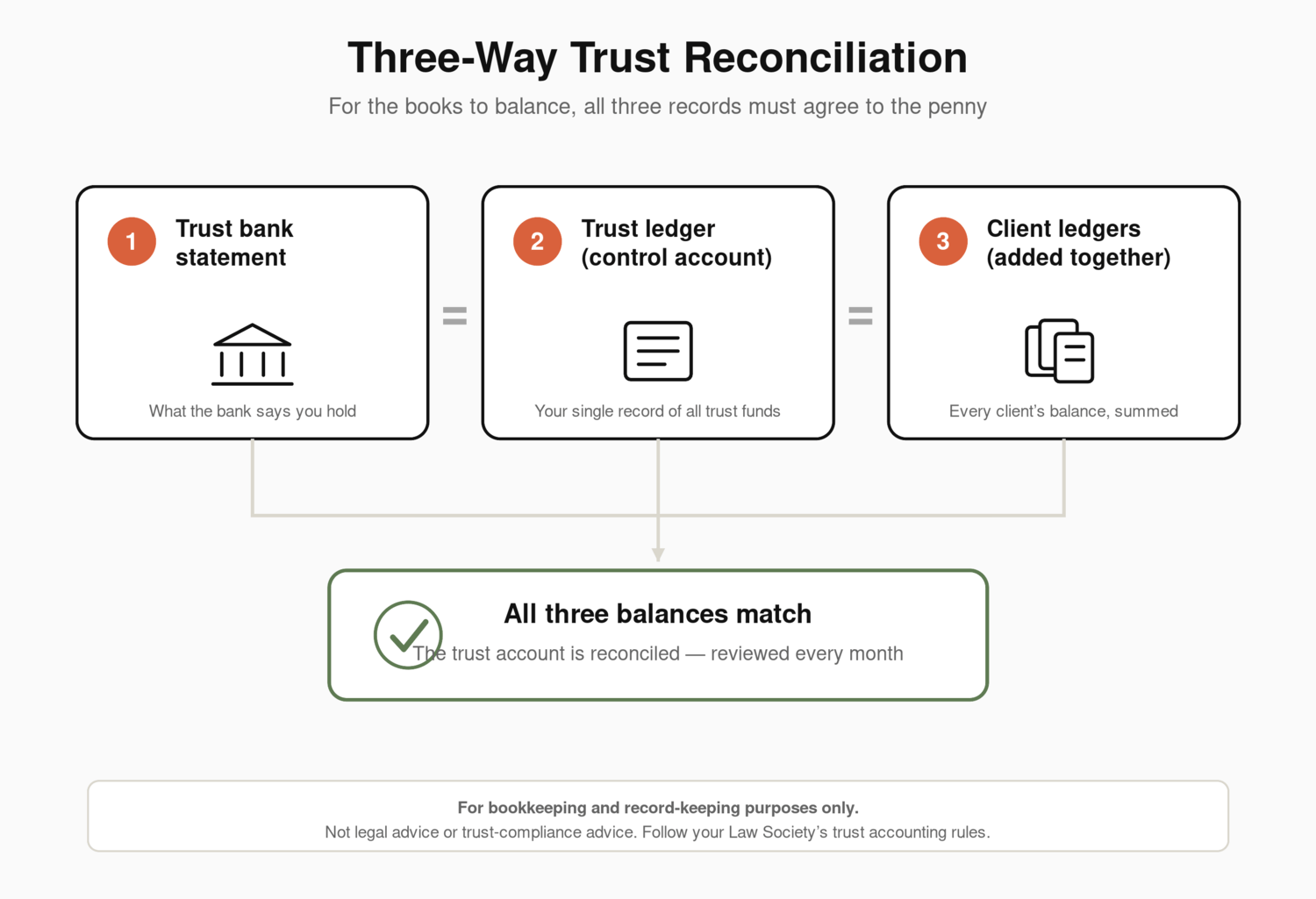
Trust reconciliation is the process of confirming that the various records of your firm’s trust money all agree with one another. In practical terms, it means bringing three things into alignment: the trust bank account, your trust ledger (the overall record of trust activity), and your individual client trust ledgers (the record of how much is held for each specific client or matter).
When a firm holds money in trust, every dollar in the trust bank account should be traceable to a specific client. A trust reconciliation proves that link. It demonstrates that the balance in the bank matches the total of your trust ledger, and that this total in turn matches the sum of every individual client’s trust balance. When all three tie out to the same number, your trust records are reconciled. When they don’t, there’s a discrepancy that needs to be found and explained.
This is fundamentally different from reconciling an ordinary business bank account. With a general account, you’re confirming that your books match the bank. With trust, you’re also confirming that no client’s funds have been mixed up with another’s and that the firm is never holding less in trust than it’s supposed to be. That extra layer, the matter-by-matter accuracy, is what makes trust reconciliation a specialized bookkeeping task.
Why Trust Reconciliation Matters
Trust reconciliation matters because trust money isn’t the firm’s money. Clients hand it over on the understanding that it will be safeguarded, tracked precisely, and used only as intended. The reconciliation is what proves, on an ongoing basis, that this is actually happening.
Done consistently, trust reconciliation gives a firm confidence and clean records. It confirms that client funds are fully accounted for, that the trust account is never inadvertently overdrawn against a particular client’s balance, and that the firm can answer, at any moment, exactly how much it holds and for whom. That kind of clarity protects clients, supports the firm’s professional standing, and removes a significant source of background stress for the practitioners running the firm.
Regular reconciliation also catches problems while they’re small. A bank error, a transaction posted to the wrong matter, or a timing difference is far easier to identify and correct within days than months later, buried under subsequent activity. In a busy practice, that early detection is often the difference between a quick fix and a tangled mess.
The Risks of Inaccurate Trust Records
When trust records are inaccurate or out of date, the consequences are more serious than with ordinary bookkeeping. The most basic risk is losing track of whose money is whose. If individual client ledgers drift out of agreement with the trust bank balance, the firm can no longer say with certainty how much it holds for each client, which undermines the entire purpose of a trust account.
Inaccurate records also create the risk of a shortfall, where the trust account holds less than the firm is responsible for, or of funds effectively being borrowed from one client to cover another, even unintentionally. These are among the most serious situations a practice can find itself in, and they often begin not with any wrongdoing but with sloppy bookkeeping: missed reconciliations, miscategorized transactions, or disbursements recorded against the wrong matter.
There are practical risks too. Disorganized trust records make any review, internal or external, far more difficult and time-consuming. They make it harder to respond promptly if questions arise about a particular matter. And they tend to compound, with each unreconciled month making the next one harder to sort out. The longer inaccuracies sit, the more expensive and stressful they become to unwind. Sound trust bookkeeping is, in large part, about never letting that backlog form in the first place.
Monthly Trust Reconciliation Best Practices
Keeping trust records clean is mostly a matter of consistent, disciplined habits. The following practices help Ontario law firms keep their trust bookkeeping accurate month after month.
Reconcile on a regular monthly schedule. Treat trust reconciliation as a fixed monthly routine rather than something done only when time allows. A predictable cadence keeps discrepancies small and recent, and ensures the three records, bank, trust ledger, and client ledgers, are brought into agreement every period.
Reconcile all three records together. A complete trust reconciliation isn’t just matching the books to the bank. It confirms that the trust bank balance, the trust ledger total, and the sum of all individual client ledgers agree. Checking all three each month is what proves every client’s funds are fully and accurately accounted for.
Record trust activity promptly and to the correct matter. Enter trust receipts and disbursements as they happen, and always against the right client and matter. Most reconciliation headaches trace back to transactions that were delayed or posted to the wrong file. Timely, accurate entry prevents the majority of month-end surprises.
Keep trust and general funds strictly separate. Maintain a clear line between client trust money and the firm’s own funds at every stage of the bookkeeping. Clean separation is the foundation that makes reconciliation meaningful and keeps the records defensible.
Investigate every discrepancy immediately. When something doesn’t tie out, find and explain the cause before moving on, rather than carrying an unexplained difference forward. Resolving issues in the same period they arise keeps them from accumulating into something far harder to untangle.
Maintain organized, well-documented records. Keep your trust documentation, statements, and reconciliations orderly and easy to retrieve. Good organization makes each month’s reconciliation faster and ensures records are ready whenever they’re needed.
Use properly configured software and a knowledgeable bookkeeper. Trust reconciliation is far smoother when your bookkeeping system is set up for the way legal accounting works and maintained by someone who understands trust requirements. The right setup and the right support turn reconciliation from a recurring worry into a routine task.
Common Bookkeeping Mistakes to Avoid
Even firms with good intentions run into trouble when certain habits creep in. One of the most common mistakes is letting reconciliations fall behind. Skipping a month or two feels harmless in the moment, but unreconciled periods stack up quickly and make every subsequent month harder to balance.
Another frequent error is reconciling only the bank balance while neglecting the individual client ledgers. A trust account can appear to “balance” against the bank while still hiding errors at the matter level, which is exactly what the client-by-client check is meant to catch. Closely related is misallocating transactions, recording a receipt or disbursement against the wrong matter, which quietly throws individual balances out even when the overall total looks right.
Other recurring mistakes include relying on generic accounting software that wasn’t configured for legal trust accounting, mixing trust and general transactions through unclear processes, carrying forward unexplained discrepancies instead of resolving them, and depending on a generalist bookkeeper who doesn’t understand the specific demands of a law firm’s books. Each of these, on its own, can turn clean trust records messy over time. Avoiding them comes down to consistency, the right tools, and bookkeeping support that genuinely understands how legal trust accounting operates.
How BKInk Supports Ontario Law Firms
BKInk is a bookkeeping specialist that understands the operational realities of Ontario law firms. We support the bookkeeping behind your trust accounts, keeping trust and general funds properly separated, recording trust activity accurately and against the correct matter, and performing regular monthly trust reconciliations so your records stay current and in agreement. When discrepancies appear, we work to identify and resolve them promptly rather than letting them accumulate.
We work in QuickBooks Online, structured for the needs of a legal practice, and we keep your general bookkeeping, HST, and payroll organized in the same consistent system. Our role is to provide accurate, well-documented bookkeeping, not legal or compliance advice, so that the people responsible for your firm’s compliance always have reliable numbers to rely on. You can learn more on our Law Firm Bookkeeping page, explore our full Bookkeeping Services, or, if your file needs setup or cleanup first, see our Support for QuickBooks Online.
Frequently Asked Questions
1. What is a trust reconciliation for a law firm?
It’s the process of confirming that a firm’s trust records all agree: the trust bank account, the overall trust ledger, and each individual client’s trust ledger should tie out to the same total. When they match, it shows that every dollar held in trust is accounted for and traceable to a specific client. It goes a step beyond an ordinary bank reconciliation because it also verifies accuracy at the individual matter level.
2. How often should a law firm reconcile its trust account?
As a bookkeeping best practice, trust reconciliation should be done on a regular monthly schedule. Reconciling consistently each month keeps any discrepancies small and recent and ensures client funds are continually accounted for. Your firm should confirm its specific obligations with the Law Society of Ontario and its professional advisors; our role is to keep the underlying bookkeeping accurate and current.
3. What happens if trust records aren’t accurate?
Inaccurate trust records can mean a firm loses certainty over how much it holds for each client, and in serious cases can lead to shortfalls or to one client’s funds effectively covering another’s. Even short of that, disorganized records make reviews harder, slow down responses to client questions, and compound month over month. Most of these problems start with bookkeeping issues like missed reconciliations or misposted transactions, which is exactly what disciplined trust bookkeeping prevents.
4. Can BKInk help if our trust reconciliations are behind?
Yes. We regularly help firms whose reconciliations have fallen behind. We work through the records period by period, reconciling the bank, trust ledger, and client ledgers, identifying and explaining discrepancies, and bringing everything current. From there we keep your trust bookkeeping reconciled on a consistent monthly basis going forward.
5. Does BKInk provide legal or compliance advice on trust accounting?
No. BKInk provides bookkeeping services, not legal or compliance advice. Responsibility for meeting Law Society of Ontario requirements stays with the firm and its licensees. What we do is keep the bookkeeping behind your trust accounts accurate, well-organized, and reconciled, so that you and your advisors have dependable records to rely on.
6. What software do you use for law firm trust bookkeeping?
We work in QuickBooks Online, structured for the way a legal practice operates. If your firm also uses dedicated legal practice-management or trust software, we focus on keeping your QuickBooks Online bookkeeping accurate and reconciled alongside it. If your file needs to be set up correctly or cleaned up first, our Support for QuickBooks Online can handle that.
Related Pages
Related pages:
- Law Firm Bookkeeping — Our specialized bookkeeping support for Ontario law firms, including trust accounting.
- Bookkeeping Services — Full monthly bookkeeping that keeps your firm’s books accurate and current.
- Support for QuickBooks Online — Setup, cleanup, and ongoing support for your firm’s QuickBooks Online file.
Leave a Reply